Shigella/EIEC and Salmonella spp
The test is designed for the detection of Shigella spp., enteroinvasive Escherichia coli (EIEC), and Salmonella spp. DNA in human biological material by real-time PCR.Category «Enteric infections»

Shigella/EIEC and Salmonella spp
Shigella spp. and enteroinvasive E. coli (EIEC) are Gram-negative bacteria that are common causative agents of acute enteric infections (shigellosis and escherichiosis). Shigella spp. and EIEC share similar pathogenicity mechanisms aimed at the invasion and destruction of the colonic epithelium. In terms of their microbiological and epidemiological characteristics, EIEC are virtually indistinguishable from Shigella spp.
Salmonella spp. are Gram-negative bacteria, the most clinically significant representatives of which for humans are S. enterica serovars Typhi and Paratyphi (the causative agents of typhoid and paratyphoid fevers) and numerous other serovars that cause an acute enteric infection—salmonellosis.
The primary route of transmission for these infections is fecal–oral, occurring via foodborne, waterborne, and contact routes. The sources of infection for salmonellosis, shigellosis, and escherichiosis include humans (both symptomatic individuals and asymptomatic carriers) and animals (the latter being particularly relevant for salmonellosis and escherichiosis).
Upon entering the gastrointestinal tract, these pathogens overcome the muco-epithelial barrier, adhere to enterocytes, colonize and damage the intestinal mucosa, triggering a local inflammatory response and a systemic immune reaction.

Diseases caused by Shigella/EIEC and Salmonella spp.
- Acute enteric infections (AEIs): characterized by the intoxication syndrome (fever, headache, weakness, nausea, vomiting, and diarrhea);
- Shigellosis: typically presents with colitis, including mucus and blood in the stool (“rectal spit”), and tenesmus;
- Salmonellosis: most commonly manifests as gastroenteritis, with symptoms such as fever, nausea, vomiting, and profuse watery diarrhea;
- Typhoid and paratyphoid fevers (caused by S. enterica serovars Typhi and Paratyphi): characterized by a prolonged fever, intoxication, bacteremia, rose-colored rash, involvement of the intestinal lymphatic system, and hepatosplenomegaly;
- Generalized forms of salmonellosis (typhoid-like and septicopyemic variants): may lead to sepsis, meningitis, osteomyelitis, and other clinically significant complications, particularly in immunocompromised patients.

Shigella spp. and EIEC are associated with severe complications, including hemolytic uremic syndrome (HUS), reactive arthritis, and Reiter’s syndrome. Infections caused by Salmonella spp. may result in a long-term bacterial carriage, abscess formation in internal organs, and chronicity of the infectious and inflammatory process.
Molecular genetic testing designed for the simultaneous detection of Shigella/EIEC and Salmonella spp. is one of the most accurate and rapid diagnostic methods
For the full phenotypic expression of pathogenicity in Shigella spp. and EIEC, the presence of the primary ipaH gene (invasive plasmid antigen H) is required. This gene is located on the chromosome as part of the large F-type plasmid (pINV). The ipaH genes encode proteins responsible for bacterial replication and dissemination within epithelial cells, in the intestinal lumen, and beyond. In addition to ipaH, the invE gene, a transcriptional regulator of the large pINV virulence plasmid, also plays a key role.
The presence of pINV is characteristic only of Shigella spp. and EIEC; in its absence, the strain exhibits an avirulent phenotype. Therefore, to detect Shigella spp. and EIEC, the identification of ipaH and invE genes can be used; detection of at least one of these genes indicates the presence of Shigella/EIEC in the sample.
Indications
-
 Differential diagnosis of acute enteric infections
 -
 Evaluation of patients with symptoms of colitis (frequent stools with blood and mucus)
 -
 Diagnosis of typhoid and paratyphoid fevers in cases with a compatible clinical presentation
 -
 Screening of contacts and identification of bacterial carriers
 -
 Monitoring the effectiveness of antibacterial therapy
Shigella/EIEC and Salmonella spp.
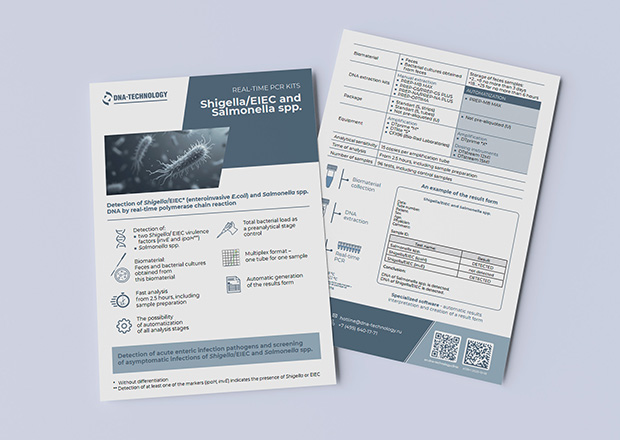
The Shigella/EIEC and Salmonella spp. REAL-TIME PCR Detection Kit is an in vitro Nucleic Acid Test (NAT) – pathogen-detection-based product.
The Shigella/EIEC and Salmonella spp. REAL-TIME PCR Detection Kit is designed to detect DNA of Shigella and enteroinvasive E.coli (EIEC) (without differentiation) and Salmonella genus pathovar bacteria in human biological material (feces) and bacterial cultures obtained from this biomaterial, by real-time PCR.
Sample: Feces; bacterial cultures obtained from feces
READ MORE
Information
Ask questions
Please note that the specialists of the DNA Technology company provide consultations exclusively to medical specialists on the application and research features. Requests related to the appointment, delivery, or interpretation of tests are not considered. For relevant information, we recommend contacting the laboratory directly.