BacScreen-OM
A test for detecting DNA of opportunistic bacteria of Bacilli, Betaproteobacteria and Gammaproteobacteria classes causing nosocomial and out-of-hospital infections.

Nosocomial and community-acquired infections and antimicrobial resistance
Departments of healthcare facilities are characterized by a specific composition of hospital flora with a predominance of certain types of microorganisms that can cause infections of different localization and severity. They can also underlie out-of-hospital infections, for example, those of the upper and lower respiratory and urinary tracts, skin and soft tissues, etc. In many cases, both nosocomial and out-of-hospital infections are caused by opportunistic microorganisms (OM). These infections can be particularly severe in patients with chronic conditions.
Class Bacilli
Class Bacilli includes numerous opportunistic bacteria:
- Enterococcus spp. Includes Enterococcus faecalis and Enterococcus faecium species, which cause urinary tract infections, infective endocarditis, and others.
- Streptococcus spp.Consists of a multitude of species, among which are Streptococcus agalactiae (a major cause of neonatal infections including sepsis, pneumonia, and meningitis), Streptococcus pyogenes (causes pharyngitis, impetigo, rheumatic fever, and glomerulonephritis), and Streptococcus pneumoniae (the cause of pneumonia, meningitis, sinusitis, and otitis).
- Staphylococcus spp. One of the members of the genus is Staphylococcus aureus, which causes a wide range of symptoms - from skin lesions to severe systemic infections such as osteomyelitis, endocarditis and sepsis. Methicillin-resistant strains (MRSA) are widespread in healthcare institutions and present a major health threat.
Class Betaproteobacteria
Class Betaproteobacteria includes several bacterial species associated with nosocomial infections:
- Achromobacter ruhlandii and Achromobacter xylosoxidans cause respiratory tract infections and are especially dangerous for patients with cystic fibrosis.
- Burkholderia spp. can cause infections (pneumonia, sepsis and urinary tract infections) in immunocompromized patients.

Class Gammaproteobacteria
Class Gammaproteobacteria includes numerous important pathogens, commonly found in hospitals as well as in out-of-hospital settings:
- Acinetobacter spp. Often associated with nosocomial infections, including pneumonia, especially in mechanically ventilated patients. A. baumannii is among the particularly significant ESKAPE multidrug-resistant pathogens.
- Citrobacter spp. Includes Citrobacter freundii and Citrobacter koseri, which can cause urinary tract infections, sepsis, and meningitis in newborns.
- The order Enterobacteriales includes genera such as Enterobacter, Escherichia, Klebsiella, Serratia and others. Enterobacter cloacae and Escherichia coli often cause urinary tract and intestinal infections.
- Haemophilus spp. The genus Haemophilus includes a number of clinically significant species (H. influenzae, H. parainfluenzae, H. haemolyticus, etc.). Haemophilus influenzae causes pneumonia, meningitis, and sinusitis. More than 90% of invasive variants of H. influenzae infection occur in children under the age of 5, predominantly in infants. It is also one of the main pathogens of lung infection in patients with cystic fibrosis.
- Klebsiella spp. Includes Klebsiella pneumoniae and Klebsiella oxytoca which cause pneumonia, urinary tract infections, and sepsis.
- Morganella morganii. Can cause urinary tract and wound infections.
- Proteus spp., P. mirabilis, P. vulgaris frequently cause urinary tract infections, wound infections and meningitis.
- Pseudomonas aeruginosa. Causes urinary tract infections and pneumonia, particularly harmful to patients with cystic fibrosis.
- Serratia marcescens. Causes respiratory and urogenital tract infections.
- Stenotrophomonas maltophilia. Often causes pneumonia and bacteremia in patients with compromised immune systems.

Comprehensive research
For effective diagnosis of nosocomial and out-of-hospital infections and timely prescription of optimal therapy PCR detection kit “BacScreen OM” is recommended for use in conjunction with “BacResista GLA/BacResista GLA Van/Mec”. “BacScreen OM” makes it possible to identify opportunistic microorganisms and determine the proportion of each pathogen in a sample. Conclusions of “BacResista GLA” and “BacResista GLA Van/Mec” (reduced version) tests contain information about the presence of antibiotic resistance genes in bacteria, reducing the time needed for optimal antibiotic therapy selection.
ADVANTAGES OF PCR-BASED DIAGNOSTICS COMPARED TO OTHER DIAGNOSTIC METHODS FOR BACTERIAL INFECTIONS
- Identification of microorganisms down to a given taxonomic rank: precise pathogen detection for prescribing treatment
- Detection of hard-to-culture microorganisms
- Quick test results
- High sensitivity
- No need to handle living bacterial cultures to perform the analysis
- A wide range of biomaterials can be analyzed
Indications for testing
-
 Infectious complications in hospitalized patients (intensive care units, burn unit, etc.)
 -
 Infectious complications in oncologic patients
 -
 Presence of invasive devices (intubation tubes, catheters, drains)
 -
 Violation of skin integrity: wounds, burns, bedsores
 -
 Infections of postoperative wounds
 -
 Upper and lower respiratory and urinary tract infections
 -
 Respiratory tract infections in patients with cystic fibrosis
 -
 Immunodeficiency disorders
 -
 Neonatal infections
 -
 Fever of unclear genesis
BacScreen-OM
BacScreen ОM REAL-TIME PCR Detection Kit is intended for DNA analysis of opportunistic bacteria from classes Bacilli, Betaproteobacteria и Gammaproteobacteria that cause nosocomial and community-acquired infections in DNA material obtained from human biological samples and bacterial cultures.
Samples: human biological material (sputum, urine, swabs of epithelial cells from respiratory tract, gastrointestinal tract and urogenital tract, feces, aspirates, exudates) and bacterial cultures
READ MORE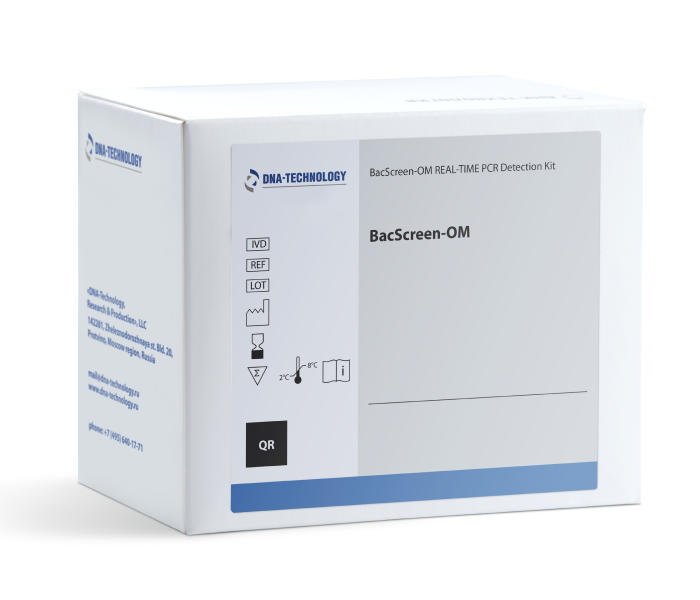
Information


Ask questions
Please note that the specialists of the DNA Technology company provide consultations exclusively to medical specialists on the application and research features. Requests related to the appointment, delivery, or interpretation of tests are not considered. For relevant information, we recommend contacting the laboratory directly.